Worried about keeping your kids safe away from home? Child safe family travel comes down to a few habits: secure seating, close supervision, a plan if you get separated, and a little rehearsal.
| Item | Value |
|---|---|
| Rear seat of vehicles for children | under 13 years of age |
| Break on a long road trip | about every two hours |
| Shoe removal at routine airport screening not required | children age 12 and younger |
| Children who can use the aircraft seat belt | those who weigh more than 40 lbs |
| Sunscreen reapplication | every 2 hours |
| Sunscreen not recommended for babies | under six months of age |
These figures come from the AAP’s HealthyChildren.org travel safety tips and the Sydney Children’s Hospitals Network travel safety page. Guidance can change, so check the source before you rely on them.
Plan before you go
Preparation does most of the safety work. The Sydney Children’s Hospitals Network says to plan ahead by thinking about travel routes, researching your destination and accommodation, and noting where you may have waiting times, as set out on its travel safety page.
Put your plan on paper with the family travel safety checklist, which gathers packing and preparation in one place. The same Sydney guidance suggests a checklist of essentials, plus a good supply of nappies and baby wipes if your child is still young.
Then talk the trip through with your child. According to the Sydney network, early expectations and rough guidelines make you much more likely to have a good time, so explain what to expect.
Health and vaccines
For an international trip, book a pediatrician visit early. The AAP advises that you check whether your child needs additional vaccines or preventive medications and is up to date on routine vaccinations, as stated on HealthyChildren.org.
The same page says to bring mosquito protection in countries where mosquito-borne diseases such as malaria are present. Ask your pediatrician what suits your destination and your child’s age.
Holiday travel guidance on HealthyChildren.org adds that you should pay attention to places with measles outbreaks. Infants typically get the MMR vaccine at 12 months old, but around outbreaks and travel babies can get it as early as 6 months old, so check with your pediatrician.
Documents
Passport, consent and entry requirements differ by destination. Read travel documents for children early, and confirm the details with the official pages for the countries you will visit.
Getting there safely: car, plane and public transport
Car, taxi and rideshare
Start with the car seat. The AAP says infants and toddlers should ride rear-facing as long as possible, until they reach the highest weight or height the manufacturer allows, and then move to a forward-facing seat (AAP).
After the harness seat, a belt-positioning booster comes next, until the vehicle’s seat belt fits properly. The AAP also says children under 13 years of age should ride in the rear seat (source).
For younger children, the Sydney network says to use the correct car seat if your child is under seven years old, and that children aged under seven years should not sit in the front seat. It also advises you to avoid overcrowded vehicles where passengers have to hold on (Sydney Children’s Hospitals Network).
Seat belts matter in cabs too: the AAP suggests setting an example by buckling up even in a taxi or ride-share (AAP). For rideshares, the Polly Klaas Foundation says to verify the driver and the vehicle’s license plate against the app before your child gets in (Polly Klaas Foundation).
The AAP warns that road travel can be extremely hazardous in developing countries. It suggests telling your driver you are not in a hurry and asking for no cell phone use (AAP).
Never leave your child alone in a car, even for a minute, as the AAP puts it.
Flying
Airports reward patience. The AAP advises you to allow extra time for security, especially with younger children, and to talk through the screening process before you arrive. Children age 12 and younger are not required to remove their shoes for routine screening, according to HealthyChildren.org.
For terminal-by-terminal detail, read airport safety tips with kids.
On seating, the AAP notes that the FAA allows children under age 2 to be held on an adult’s lap, yet the AAP recommends that each child have their own seat (AAP). Separate holiday guidance says the FAA recommends reserving a separate seat for babies or toddlers (HealthyChildren.org). Neither page shows a publication date in the text supplied, so confirm current airline and FAA rules before you book.
Restraint details are where families most often need to check the fine print:
- Airlines will typically allow a child’s car safety seat as an extra luggage item with no additional luggage expense, so check the airline’s website for its policy (AAP).
- The car safety seat should have a label noting FAA approval (AAP).
- Belt-positioning booster seats cannot be used on airplanes (AAP).
- Children who weigh more than 40 lbs can use the aircraft seat belt (AAP).
Public transport
Crowded platforms and buses are easier with a routine. The Polly Klaas Foundation suggests that children board together as one unit, stand back from platform edges and agree on meeting landmarks at major stations (Polly Klaas Foundation).
- Keep children seated when possible, and use verbal check-ins before every stop.
- If doors close unexpectedly, teach children to wait with transit staff rather than run after a moving train or bus.
- Cross at designated crossing areas, and learn the local road rules, such as keeping to the left or right, before you cross (Sydney Children’s Hospitals Network).
Local systems differ, and public transport safety with children abroad goes further on that.
Where you stay: hotels, rentals and ships
A child-friendly room is more than a cot. The Sydney network suggests choosing accommodation where pools, pool fences and balconies are safe and meet Australian standards, and calling ahead to confirm amenities (Sydney Children’s Hospitals Network). You can compare options using the steps in how to choose a child friendly hotel.
On arrival, run a room check, following the Polly Klaas Foundation’s advice (source):
- Check window locks, balcony access and electrical outlets.
- Never leave children unattended in hotel rooms, even briefly.
- Teach children never to open the hotel room door without adult permission.
- Use all available locks, including deadbolts and chain locks.
The Sydney network also warns that facilities such as a playground may not have the same safety standards as Australia, so supervise closely (source).
For houses and apartments, the vacation rental safety with kids guide adds to these checks, and the cruise safety with kids guide does the same for ships.
Preventing separation and preparing your child to respond
The Polly Klaas Foundation notes that travel combines crowds, fatigue, unfamiliar environments and schedule pressure, which makes separation easier (Polly Klaas Foundation). It also keeps risk in perspective: the National Center for Missing & Exploited Children notes that nonfamily abductions are rare among missing-child cases, yet rare is not the same as impossible.
That guidance frames three goals for a practical travel safety approach:
- Prevent separation.
- Prepare children to respond if separation happens.
- Reduce avoidable injury risks in new environments.
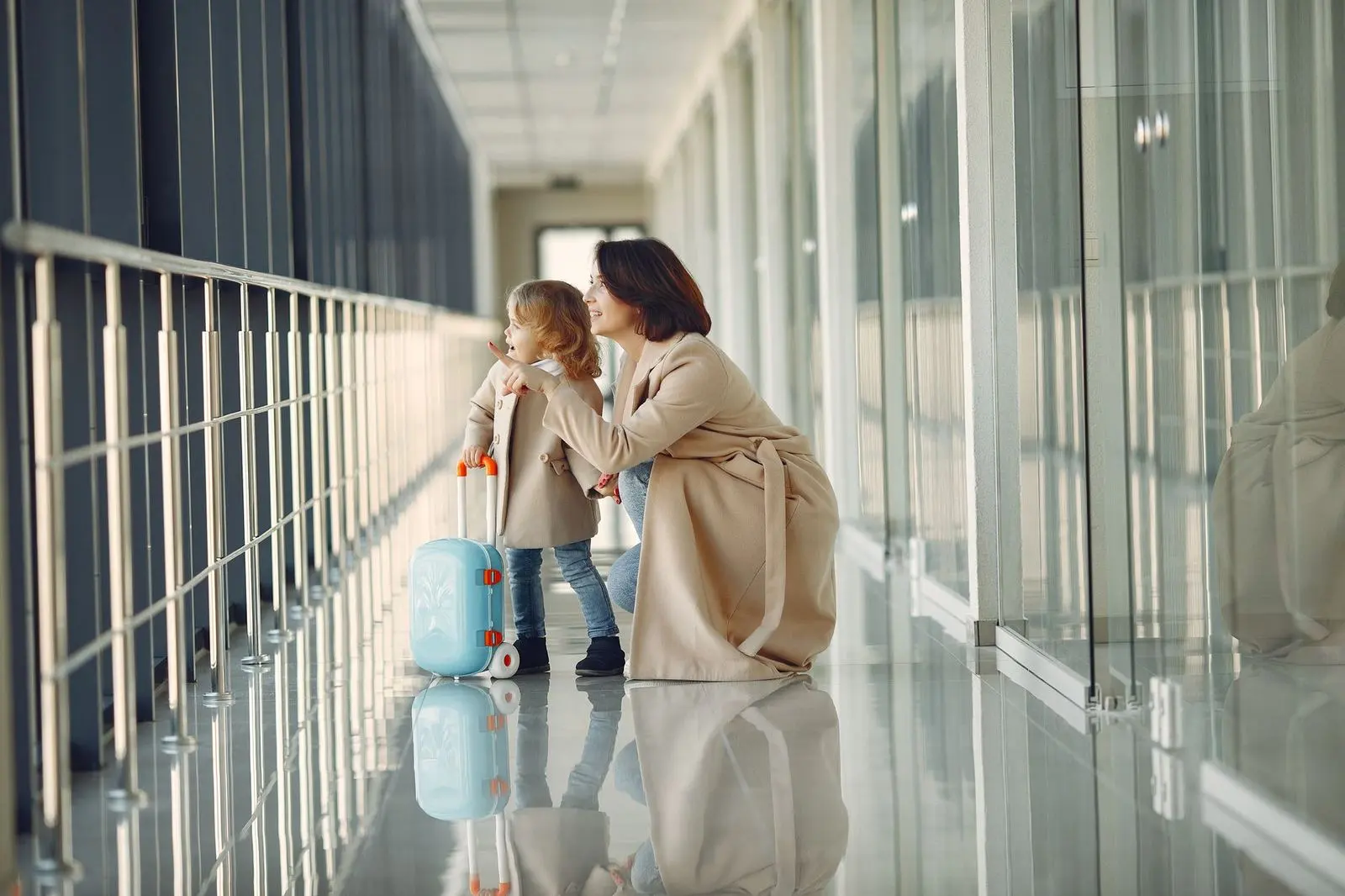
At the airport and in crowds
For airports, the Polly Klaas Foundation suggests the following habits:
- Set clear meeting points with older children, such as a particular gate or the information desk rather than a vague area.
- For younger children, consider temporary tattoos with your contact number, or identification bracelets.
- Dress children in bright, easily identifiable clothing, and take a photo of your child each morning of travel in their current outfit.
- Keep physical contact in crowded areas through hand-holding or child carriers.
- Tell children to approach uniformed airport staff if they are lost.
Teach and rehearse
Teach your child their full name, your phone number and how to identify trustworthy adults in public spaces, as advised by the Polly Klaas Foundation.
Children remember what they rehearse, and role-play works best when it is calm, brief and repeated. Guidance on age-appropriate wording is in the piece on talking to kids about staying safe while traveling.
If separation does happen, the steps in what to do if your child gets lost while traveling help you stay calm and act quickly.
Sun, heat and water on holiday
Reapply sunscreen every 2 hours, or more often if your child is sweating or swimming. For babies under six months of age, the Sydney network says to use protective clothing, hats and shade instead (Sydney Children’s Hospitals Network).
The same page notes that children don’t regulate heat as well as adults, and their activity level is usually higher on holiday. Regular breaks, good meals and clean drinking water help (source).
Near water, close supervision applies to beaches, lakes, rock pools and shallow water alike. The Sydney guidance adds that children should not step on or touch anything suspicious in shallow water or rock pools, and should wear non-slip water shoes. More is in water safety for kids on vacation.
How can you travel more responsibly with children?
Responsible travel with children includes knowing who looks after them. The Sydney network advises you to follow child protection recommendations and keep close supervision, and to be extra attentive in busy and foreign environments (source).
Before you book childcare, clubs or activities, it suggests checking:
- staff qualifications and background checks
- child protection policies
- service accreditations
- how many staff look after children at any one time
The wider picture is covered in responsible tourism for families.
This site is an independent educational guide, not a child-protection body, and it does not take reports or enquiries. For official advice, the Sydney network points to the Smart Traveller service for travelling with children.
Frequently asked questions
How often should you stop on a long road trip?
Show answer
The AAP suggests a break about every two hours for you and your child. Pointing out interesting sights, and bringing soft, lightweight toys and favorite music, can keep children from getting restless (HealthyChildren.org).
Can your child fly after an ear infection?
Show answer
Talk with your pediatrician first if you plan to fly within 2 weeks of an ear infection or ear surgery. To ease ear pain on descent, the AAP suggests nursing or a bottle for infants, and chewing gum or a straw for older children (HealthyChildren.org).
Can you rely on a rental car company for a child seat?
Show answer
Most rental car companies can arrange one, but the selection may be limited. Before you accept it, check that it suits your child’s size and age, looks to be in good condition and comes with its instruction manual (HealthyChildren.org).
Is travel insurance still worth it if you have national health cover?
Show answer
The Sydney network says national healthcare is unlikely to cover you in most countries, and even reciprocal agreements may not cover every cost, so it still strongly recommends travel insurance. It suggests booking through a trusted provider once your destinations and dates are set (Sydney Children’s Hospitals Network).